The Tech for Social Good “Student-Led Events & Programming Track” provides funding support of $200 – $1,000 for UC Berkeley individual students, student organizations or student groups to develop events or programming that improve and support technological innovations that support healthy, sustainable, and connected communities. Events and programming that support diversity and inclusion in tech are also encouraged.
2018-2019 Funded Events & Programs
Innovate Berkeley
Innovate Berkeley’s Innovation Summit is a combination of educational and exploratory weekend series and a hackathon-like event, with the goal of creating tangible technological and non-technical solutions to mitigate problems on campus that our peers, faculty, and administration face.
CubStart
Launched in collaboration with CalHacks, CubStart is a beginner hacker program to help hackathons be less intimidating and more accessible for everyone! The program provides mentorship for team building and training in ideation and basic technical skills to encourage those with little or no CS experience to try out hackathons and coding!
Privacy Lab hosted by IRGP in collaboration with Mozilla
The May iteration of Privacy Lab featured a privacy author round-table hosted by the Interdisciplinary Research Group on Privacy at Berkeley (IRGP). The event brought together prominent authors of privacy books to discuss their work and privacy more generally. For the first time, Privacy Lab will be coordinated with the annual Privacy Law Scholars Conference (PLSC).
Using Open-Source Intelligence (OSINT) Tech for Human Rights Investigations
Hosted in collaboration by students within the Human Rights Center at Berkeley Law and the International Relations Council of Berkeley, the “Using OSINT Tech for Human Rights Investigations” workshop taught cutting-edge open source investigation tools and techniques to more than 50 students. Learn more here.
2017-2018 Funded Events & Programs
|
|
Big Ideas Big Ideas is an annual contest aimed at providing funding, support, and encouragement to interdisciplinary teams of students who have “big ideas.” Since its founding in 2006, Big Ideas has inspired innovative and high-impact student-led projects aimed at solving problems that matter to this generation. More info at bigideas.berkeley.edu |
|
|
Cal Hacks Cal Hacks is the world’s largest collegiate hackathon. Over 2,000 student hackers and innovators from across the nation converge at UC Berkeley’s California Memorial Stadium to create incredible software and hardware projects. More info at calhacks.io |
|
|
STEMpowerment lecture Co-hosted by the Graduate Women of Engineering (GWE), Prof. Talithia Williams at Harvey Mudd College provided a thought-provoking lecture on equity and inclusion in STEM. Her lecture is viewable at https://youtu.be/AT_IUbIr-_g |
|
|
STEM Fam STEM Fam is a monthly dinner series at UC Berkeley, uniting underrepresented minority (URM) graduate students and postdocs. These dinners aim to build a community among URM students and postdocs while simultaneously improving diversity in STEM through academic and career development as well as discussions about the current environment at Berkeley and how it can be improved. If you’d like to join the group or want more information, please contact Amal El-Ghazaly (aelghazaly@berkeley.edu) |
 |
GEESE Addressing the need to for a constructive and cross-disciplinary space to study and reflect on the societal implications of new technologies, Graduates for Engaged and Extended Scholarship around computing & Engineering (GEESE) aims to develop community among graduate students and postdocs interested in working at the intersection between engineering, the social sciences, and humanities. The group aims to (1) stimulate cross-disciplinary debate, scholarship and collaboration, (2) develop cross-disciplinary thought around new technologies and their societal/political implications, and (3) promote critical thinking, responsibility and engaged scholarship in engineering curricula. Interested in getting involved? Learn more at geesegraduates.org.
|
 |
BioEHSC™ BioEHSC™, a bioengineering high school competition, is a group research design competition at UC Berkeley for high school students to explore bioengineering through project-based learning under mentorship of biology and engineering undergraduate students. The high school students, in teams of four or five, are asked to identify a problem or unmet need in medical or biological engineering and propose a potential solution, backed up by literary research. BioEHSC™ serves to encourage high school students to pursue bioengineering and STEM in college. |
 |
Smogathon The Berkeley Energy & Resources Collaborative (BERC), together with CITRIS, co-hosted a semifinal of the global anti-air pollution pitch competition, Smogathon. Smogathon selected the two finalists: Wynd from MIT, designing smart and fast air purifiers, and Artveoli from Stanford, producing fresh indoor air with photobioreactors to compete at the final stage in Krakow, Poland. |
 |
STAC 2018 Space Tech Symposium Space Tech Symposium at Berkeley (STS@Berkeley) is a gathering of space tech pioneers in industry and research. Top venture capitalists, startups, scientists, and engineers will present their visions for the future of space tech and much more. |

2016-2017 Funded Events & Programs
|
|
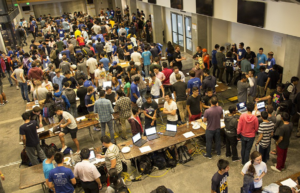
FoodInno Hackathon
FoodInno Hackathon is a one-day event, a platform linking students’ creativity with the challenges that local food businesses face through “hacking” business model solutions, which can involve designing novel products, services, and solutions. The FoodInno Club provides students with the opportunity to work closely with local food companies, co-ops, and organizations. |
|
|
Berkeley Builds Designathon
The Berkeley Builds Designathon, the first interdisciplinary social innovation designathon at UC Berkeley, was hosted by Project RISHI, Hackers @ Berkeley, ASUC, and EnableTech. The Berkeley Builds event sought to accomplish something different from the usual corporate innovation contest: this event brought together students with backgrounds and majors beyond engineering, and these multidisciplinary teams designed solutions with lasting impact for local nonprofits. |
|
|
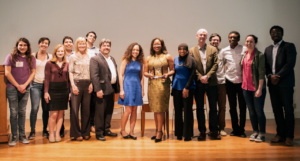
Women In Tech: A Panel at The Berkeley Forum
Despite the tech industry’s efforts towards inclusion and diversity, the number of women in some tech-related fields has plummeted. In many of the largest tech companies, women make up less than a quarter of the employee population. Women who enter the tech industry face rampant biases and stereotypes; for example, a study showed that half of women with careers in STEM fields eventually leave their jobs because of hostile work environments. This problem is just as present at UC Berkeley, as only 11% of EECS graduates in 2016 were female. This panel brought together women in the tech field to discuss solutions to the systemic issues they face. |
|
|
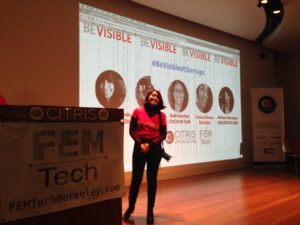
FEMTECH Talk Series FEMTech Talk is a Speaker Series that aims to inspire young women to pursue computer science, technology, and entrepreneurship, all the while providing a support system and breaking down gender and social stigmas associated with the industry by inviting women engineers from the tech industry to motivate and empower our girls. |
|
|
Build the Future DeCal How To Build The Future (CS198) is a semester-long entrepreneurship class aimed at bridging the gap between undergraduate students and startup founders. Founders like Vinod Khosla (Sun Microsystems Founder and Venture Capitalist) and Justin Kan (Co-Founder Twitch.tv) will come in to share their startup stories and learnings. Students will also be exposed to the Berkeley startup scene, including professors, student organizations, and startup resources. Sign up to take the Fall 2017 How to Build the Future DeCal.
|
|
|
Ursa Hacks UrsaHacks is committed to changing the exclusive atmosphere of contemporary hackathons. We wish to push the boundaries of the fields cultural ideology and challenge the notion that coding is reserved for computer scientist. Instead, our goal is to show that anyone from any background can use programming to benefit their lives and the lives of those around them. |